Tuesday, 23 July 2013

Breaking the Dam: Getting the Message Through

As a safety officer in the oil field, a big part of my job is to present a weekly safety meeting for all crew members. This usually happens when they have worked 12 hours and are ready for bed. Needless to say, they are not as receptive as they "should" be.

And let's face it, Safety information is NOT the most dynamic, attention-keeping information. Nobody makes box office hits about safety talks. So how do you effectively communicate this important, potentially life-saving information for

MAXIMUM RETENTION?

We don't have to reinvent the wheel. There is a high performance operational field that has to communicate safety information on a consistent basis to an audience that is almost always unreceptive. Airlines.

Airlines are required to do a safety briefing before very flight. Most people are just not in the mood to listen to a safety briefing, especially if they have heard it many times. I fly internationally quite a bit, so I see and hear all sorts of safety briefings. The one briefing that sticks out is the Delta Safety Briefing video. They recently made some changes  to the original and it is obvious that some research went into effective communication of the safety points.

The previous video had a very attractive woman with a big smile narrating through the briefing. She was easy on the eyes,  but if you had seen the video before, there was nothing to catch your attention. There were a couple of eye-brow raisers (melodramatically wagging the finger when talking about the non-smoking rule, for one) but nothing worth diverting your attention from the Sudoku puzzle.


The new video also.has an attractive woman narrating the briefing in an upbeat friendly style. The difference is some of extras.  These are some things that a speaker can use to keep the attention of his/her audience, even if the material is dry and repetitive.

1. Start with something off key
The more unusual, the better. One of the best memorization techniques is to associate what you want to remember with something totally off the wall. Joshua Foer, journalist, memory contest winner, and TED speaker, talked about the mental references that he used to win a memory contest. He used a familiar place along with unusual visualization (naked people on a bicycle, for example) to memorize his TED talk (see and hear it here)
The sexier, raunchier, more thrilling, emotionally moving, or unusual, the better the brain will retain the memory. Of course we have to operate within certain parameters of respect for our audience, but there is plenty of material out there to spark the brain's memory function.  A funny cartoon, a short video clip, pictures of a recent enjoyable event, etc. 
Delta starts their video with a short talk from the CEO then a pilot introduces the safety briefing. Not the most exciting, but not bad either.

Giving the audience a strong emotional boost will dramatically increase the efficacy of your presentation.
2. Small frequent laughs are better than the occasional big one.
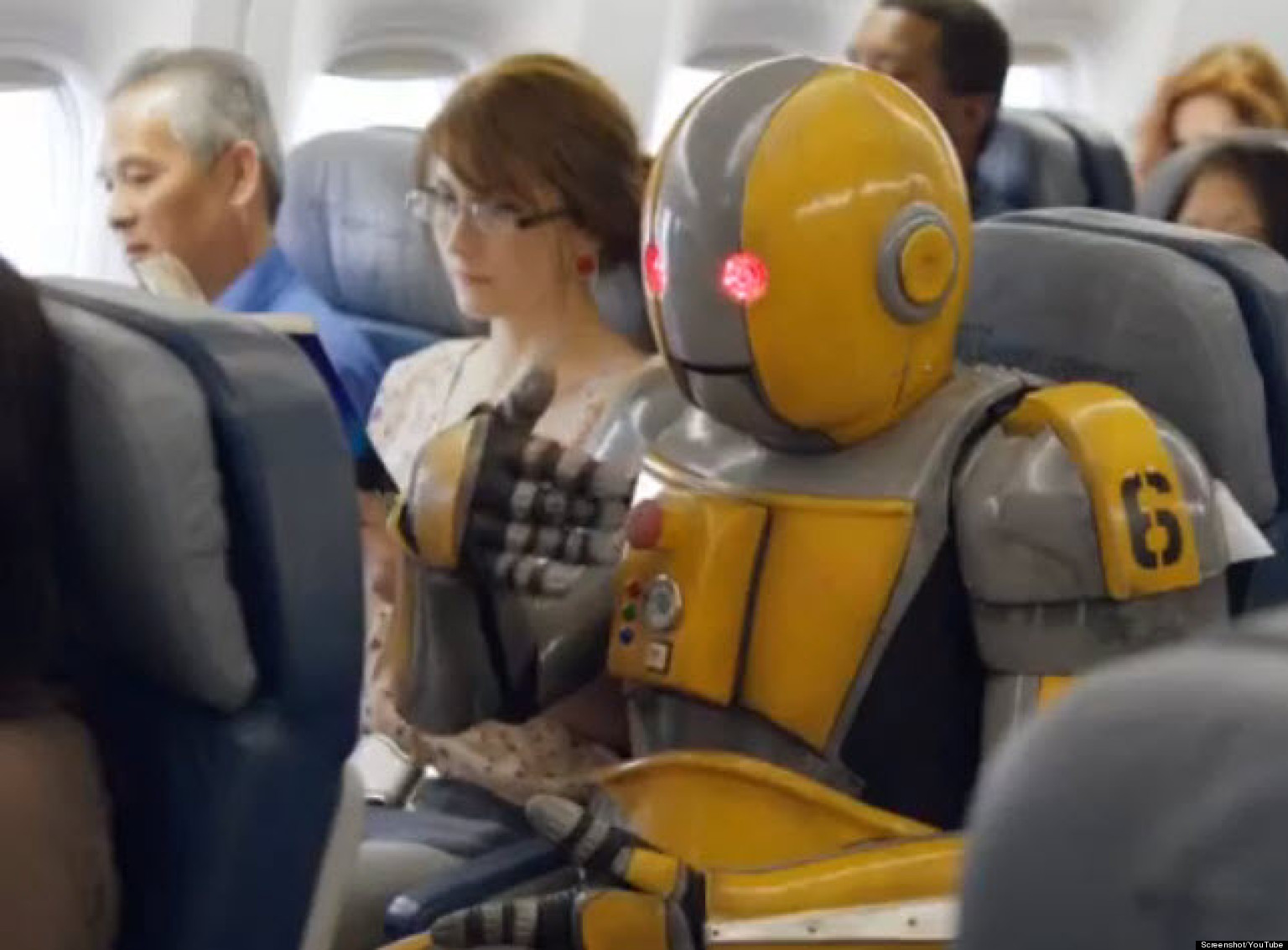
In Delta's orientation video, there are frequent little bits of comedy. No side splitters, but scene that will make you do a mini-chuckle. (That's when you just have the one quick exhale). For example, when the narrator says that electronic devices should be switched off, they show a robot shutting himself off. Not a belly laughed, but unusual enough to catch your attention.

My personal favorite is when the elderly lady with hot tea leans over the business man during the discussion about turbulence.

There are so many of these little things embedded in the video that I  find myself looking for others,  even when I've seen the video many times.


Any small emotional reaction will keep the brain from switching off and keep the memory function on.


3. Include something familiar, current, or immediately relevant
Remember when I talked about the melodramatic finger wagging by the previous video's narrator?  In the new version, they show the same attractive lady sitting in an airplane seat doing the same gesture. This 'inside joke' is familiar to passengers who have seen the previous version.


It also gives some passengers a sense of exclusivity. They will be among the limited number of people who will get that joke. They will pay more attention each time, especially to catch that little bit of familiarity.

Familiarity is a great memory tool that will increase retention. 

3. Sandwich the boring bits in with the funny bits
There are some serious parts to an airline safety briefing that just cant be addresses lightly. The information about how to apply an oxygen mask to yourself or your children must be presented in a straight forward manner. However that section of the video is preceded then proceeded by one of those little bits of humor.

The human body is programmed to avoid pain. Boredom is mental pain. When a section of the presentation is unavoidably dry, presenting something that activates pleasure centers through amusement will drastically reduce or eliminate that pain altogether. The same principle applies in using the positive sandwich for giving negative feedback.  Sandwiching the dry bit between two amusing bits will increase attentiveness and retention.

This video is a great learning tool if you look between the scenes and see the development, the human factors research, and the engineering behind it. It is specifically designed to communicate highly important safety information to a non-receptive audience for the best possible mental retention. 

If you would like to view the Delta Safety Video, here are the links. Enjoy!


Wednesday, 29 May 2013

Van Halen, M&M's and Workplace Safety (what!?!)

One of the biggest complaints that I hear from guys has to do with the paperwork. Work permits, risk assessments, job plans, etc. "What is it about checking a box that makes me safer? A piece of paper doesn't make the job safer."

Fair enough and that is somewhat correct. A piece of paper by itself won't keep anyone safe. But it's not the paper, it's the details in the process behind it.

It almost sounds like a corny joke--What do Van Halen, M&M's, and Workplace Safety have to do with each other? Once you hear the back story, it will become quite clear.

In the late 70's and early 80's, Van Halen was arguably the most popular performing band in the United States and perhaps even world wide. They were taking their huge shows into the smaller venues, which no one else had done before. Nine semi-trucks with massive amounts of equipment would pull into the venue. The the promoter would wet his pants. 

In his autobiography, David Lee Roth talks specifically about this situation. There was always the danger of electrical problems, stages not being strong enough, overhead girders unable to support the weight, etc., etc. The contract rider received by the promoter well ahead of the concert contained what was required for the entire show down to the smallest detail. Technical requirements, safety requirements, personal requirements--including a bowl of M&M's. The specific requirement (embedded in an obscure place in the contract) was that a bowl of M&M's be placed in the dressing room with all of the brown M&M's removed. Seriously.

What the line actually stated was, "...there will be no brown M&M's in the backstage area upon pain of forfeiture of the show with full compensation". Harsh. Can you imagine the promoter's face if the manager said,"I know you've spent a ton of money here in marketing, but we've found some brown M&M's in Eddie's dressing room. Oh, and you still have to pay us. And you have to refund all of those ticket sales. And explain why you can't deliver the show you promised. Have a nice day."

I never heard of that actually happening. Regardless, the potential was there. Seriously!?! Come to find out, there was a method behind the madness. Actually, ingenious.

The brown M&M's were indicators of potential problems. Mr. Roth, some light, please? "When I would walk backstage, if I saw a brown M&M in that bowl, well, line check the entire production. Guaranteed you're going to arrive at a technical error. They didn't read the contract. Guaranteed you'd run into a problem. Sometimes it would threaten to destroy the whole show. Sometimes, literally, life threatening."

While the brown M&M's request seems like a minor detail with no significance, it was an indicator of whether or not the promoter had read the contract thoroughly and whether or not there were going to be problems. 

When your workers do not complete a permit, check list, or other required documentation, it is an indicator that they have not adequately prepared for the job.

Same as the crew for Van Halen, if something is not done correctly, then there will most likely be a safety problem. Time to do a thorough check.

Ira Glass and John Flansburgh from the band They Might Be Giants talk about this story on the radio show This American Life. You can listen to it here: http://www.thisamericanlife.org/radio-archives/episode/386/fine-print


Tuesday, 26 February 2013

We've STOPPED!! Now what!?!

Once again, Vanilla Ice has the word....COLLABORATE, and listen.

Webster has the following definitions for collaborate: (http://www.merriam-webster.com/dictionary/collaborate)

1. -- to work jointly with others or together especially in an intellectual endeavor

2. -- to cooperate with or willingly assist an enemy of one's country and especially an occupying force

3. -- to cooperate with an agency or instrumentality with which one is not immediately connected

The first and third definitions are the ones we are concerned about.

(If you would like to cooperate with or willingly assist an enemy of our country, then you're on your own. God Bless America. :)

The great thing about stopping is the ability to THINK totally about the next steps, the issues, and the solutions without our brain being occupied by the continuation of the task. It also gives the group or individual the time to access resources, such as a more experienced person, manuals, procedures, etc. Even just a brain storm in the midst of a time out can be highly productive, leading to efficient and safe completion of the job.

It is too difficult to collaborate while continuing a work process.

One human characteristic that is counterproductive is the reluctance to ask for help. We want to be independent, prove ourselves on our own, and show off our work. We don't want to be a bother. But a very productive human characteristic is the desire TO help. People love to share their expertise. They love to give good advice. They also love to be appreciated for what they know and what they do. So don't hesitate to ask. Asking great questions let's the supervisor know that you know what you don't know.

IMPORTANT!!! The worker needs to feel like he can access this experience without repercussion, even in an initial reaction. (Refer to Reaction Blog)

Our spin on the third definition is to cooperate with other agencies or entities that can give you the most assistance. In this day and age, the internet is an amazing resource for all kinds of information. Many organizations will gladly give advice if they think they have a snowball's chance of selling you something.

TAKE ADVANTAGE!!

Collaborate with each other. Use information from experts. Read forums. Share information. Connect. COLLABORATE!

Don't just work safe...BE safe.


Thursday, 21 February 2013

STOP...Collaborate and Listen....

For those of you who are younger than 25, this phrase might not mean a whole lot, but for those of us who were of teenage years in 1989, they meant a lot. Most guys would openly discredit the singer Vanilla Ice, but then get in their cars, do the side-to-side look to see if anyone was watching, and play "Ice Ice Baby" as loud as possible. Classic and genius.

Genius not only because of the marketing value of the song, genius not only because the original financing for this song was only $8000 and yielded an unbelievable percentage of return, but genius because of its application to everyday life...including workplace safety.

Excuse me? When did Vanilla Ice become an occupational health and safety guru? Well, he didn't. But the beginning of the song starts in a unique way....

STOP....Collaborate and listen...

In today's workplace, it's all about go go go, time is money, productivity is key, blah blah blah, etc, etc. In most places, the word STOP is absolutely foreign. If a production line has to stop for anything, you can see the manager mentally ticking away the potential products that are not being made multiplied by the amount they cost the company equaling the lost revenue. But what is not thought about is the time SAVED by stopping.

In the late 1970's, General Motors had a plant in Fremont, California that was a huge mess of inefficiency. The line did NOT stop...for ANYTHING!! They had repair teams at the end of the assembly line to fix all of the mistakes made in the plant, which were very many. The plant closed down, but reopened in 1984 in a joint venture with Toyota. Managers had gone to Japan to see how Toyota built quality cars efficiently. One of the major contrasts is the ability for any worker on the line to stop the process at any time for any reason. In the end, cars came out with a high standard of workmanship and did not need repairs.

The complete story is on This American Life here:
http://www.thisamericanlife.org/radio-archives/episode/403/nummi

Stopping has become a workplace normality in many industries where the consequences of mistakes are huge. Surgery wards are using the Time Out before procedures to ensure that the everything is correct, the doctor knows which limb or what procedures is taking place, anesthesia is properly in place, etc. We've all heard the stories of botched surgeries and with lawyers salivating at the prospect of deep pocket hospitals with obvious liability, there is no room for error. In the highly dangerous oil field, all workers are giving the authority and responsibility for calling a Time Out for Safety when anything is amiss. As most of you have heard of the Deepwater Horizon incident in the Gulf of Mexico, the consequences of a misstep can be catastrophic.

So just STOP! That is a huge first step. Overcoming the mindset that stopping will produce a loss is a major obstacle. However, taking that time shows employees that you take them seriously, their safety seriously, and they will usually respond in a positive way.

So what then? Collaborate....and listen.  Next time.

Thanks. Don't just work safe or play safe.....BE safe.

Tuesday, 5 February 2013

Introduction

Greetings! If you are reading this blog, that means you are:

  • an employee interested in doing your job and going home with all his fingers
  • an employer who wants his employees to go home with all their fingers
  • absolutely bored and have read every other blog on the internet
If you fall into the third category, please turn off the computer and go find a productive activity. However, if you are in the first two, WELCOME!! Let me tell you a little about myself.

For the first part of my career life, I worked as a paramedic. Like Jimmy Buffet says, "Some of it's magic, some of it's tragic" but it was an honorable, rewarding career field. I eventually moved into the safety side for oil drilling companies and have been doing that for many years now. I must prefer the preventive side rather than the reactive side. Working with people from all over the world (Asia, Africa, Europe and the good ol' USA), I have found a lot of common themes in my attempts to get people to work safe. 

I have found many approaches from other fields of study that make a positive impact. That is what is is really about--making a POSITIVE impact. People generally want to enjoy their work and be satisfied with their accomplishments. Making Workplace Safety a part of that enjoyment is a truly effective way of keeping workers safe.

Thank you for reading my blog and I hope you find some useful tips for keeping you and/or your employees safe. 

Christopher Smith